Open Source Ecology: published blueprints for basic machines
Open Source Ecology is a project that sets out to design the machines a small community needs to live and build, and to publish every drawing, parts list and instruction so that anyone can make them. It became widely known around 2011 through a brick press and a tractor built on a farm in Missouri. This article explains what the project is, what it has produced and what its experience says about open hardware.
Origins
The project was started in 2003 by Marcin Jakubowski, who had trained as a physicist at the University of Wisconsin–Madison. Frustrated by the cost and fragility of farm equipment, he bought land near Maysville, Missouri, and began building the machines himself, documenting each step on a public wiki. The site, known as Factor e Farm, became the project's test ground and workshop. Volunteers came for weeks or months to help build prototypes, and others contributed designs and calculations from a distance.
The Global Village Construction Set
The project's central idea is a "construction set" of about fifty machines that, taken together, would let a community produce food, shelter, energy, tools and transport with a small modern economy. The list includes:
- Building: a compressed earth block press, a cement mixer, a sawmill and a backhoe.
- Agriculture: a tractor, a seeder, a hay rake, a bakery oven and a dairy milker.
- Industry and fabrication: a CNC torch table, a drill press, a 3D printer, a laser cutter, an induction furnace and a metal roller.
- Energy: a power cube (a modular hydraulic power unit), a wind turbine, a solar concentrator and a steam engine.
- Transport: a car and a truck.
Machines are designed to share parts. The "power cube", for example, is meant to drive the tractor, the brick press and other equipment interchangeably, so that a breakdown in one machine does not stop everything, and spare parts are common to many.
The brick press
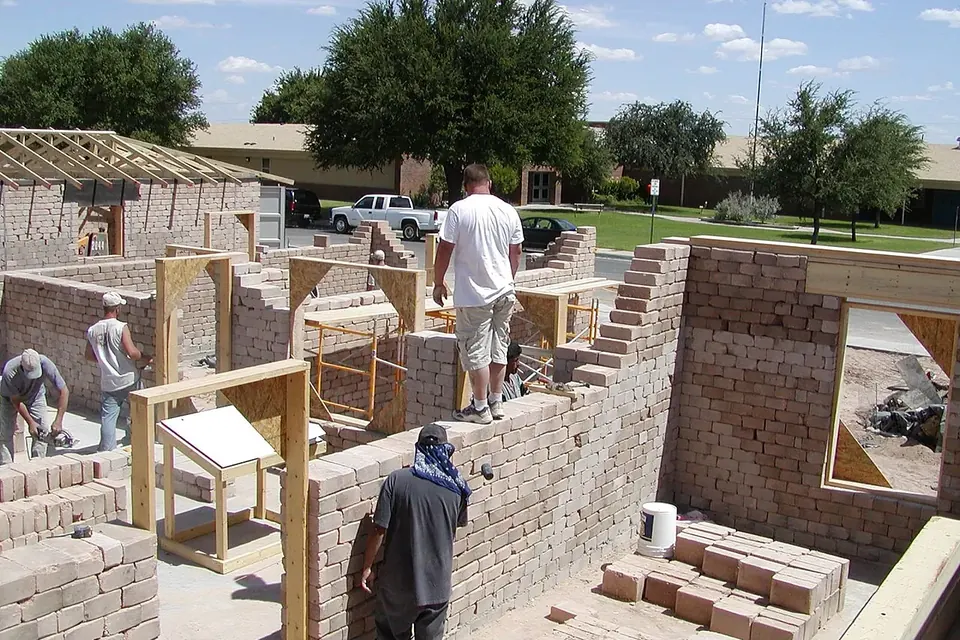
The first machine to reach a usable state was the compressed earth block press, later called the Liberator. Pressing damp soil into a mould at high pressure produces a dense block that can be laid with little or no mortar. The technique has a long history: the CINVA-Ram, a hand-operated press developed in Colombia in the 1950s, spread to many countries. Open Source Ecology's version is hydraulic and automated, designed to produce several blocks a minute with a small crew, and it was used to build structures on the farm. Earth blocks have real advantages, since the material is often available on site, but they require suitable soil, protection from rain and, in many places, stabilisation with a small share of cement or lime.
Why publish everything
Open hardware applies to physical objects the rules familiar from free software: the design files are published, anyone may study and change them, and improved versions can be shared on the same terms. The Open Source Hardware Association's definition, published in 2011, sets out these conditions. For Open Source Ecology, openness serves several aims at once:
- it lowers the cost of machines, because buyers pay for materials and labour rather than for intellectual property;
- it lets users repair and adapt their equipment instead of depending on a dealer;
- it invites contributions from engineers, students and builders worldwide;
- it supports small businesses that make and sell the machines locally, which the project calls distributive enterprise.
Public attention
A 2011 TED talk by Jakubowski, in which he presented the construction set as "blueprints for civilisation", brought the project a wide audience, and he was named a TED Fellow the same year. Press coverage followed. The attention brought funds and volunteers, but also scrutiny of how quickly the designs were maturing.
Results and difficulties
Over two decades the project has built working prototypes of a number of machines, run hands-on workshops in which participants assemble a tractor, a 3D printer or a small house in a few days, and developed a modular house design. It has also faced the problems common to open hardware:
- Documentation is hard. A machine that works on one farm needs drawings, tolerances, sourcing advice and tests before strangers can reproduce it.
- Prototypes cost money. Steel, hydraulics and engines are expensive, and every revision has to be built.
- Volunteers come and go. Long-term residencies at a remote farm proved difficult to sustain, and the project moved towards short workshops and paid staff.
- Safety and liability. Heavy machinery built from public plans raises questions of testing and responsibility that software does not.
Why it still matters
Whatever its pace, Open Source Ecology helped popularise the idea that the tools of a local economy can be shared like software. It also showed how online collaboration can feed a physical workshop: a public wiki, open calls for designers and frequent progress reports allowed people far away to follow and contribute. Many smaller projects, from open-source tractors in France to community fabrication labs in East Africa, have pursued related goals.
For readers interested in the wider movement, the same principles of published designs and local manufacture appear in community workshops and fabrication laboratories, where shared machines let people build what they need rather than buy it.
Sources
- Open Source Ecology wiki, project overview and Global Village Construction Set pages: wiki.opensourceecology.org.
- Marcin Jakubowski, "Open-sourced blueprints for civilization", TED, 2011.
- Open Source Hardware Association, Open Source Hardware (OSHW) Definition 1.0, 2011: oshwa.org/definition.
- Hugo Houben and Hubert Guillaud, Earth Construction: A Comprehensive Guide, CRATerre / Intermediate Technology Publications, 1994 (on compressed earth blocks and the CINVA-Ram).