Reaching people who are offline
An online community tends to hear only from people who are already online. Yet according to the International Telecommunication Union, about a third of the world's population had still not used the internet in 2024, and many more connect only occasionally. Networks that want to work with farmers, small traders, elderly people or rural schools have to build bridges to them. This article reviews the methods that have worked and the mistakes to avoid.
Who is offline
The ITU's annual figures show the pattern clearly. Most people who are not online live in low-income countries and in rural areas; women are less likely to be online than men in most of those countries; and older people are less connected everywhere, including in Europe and North America. Being "offline" also covers people with a phone that can receive text messages but not browse, people who can afford data only a few days a month, and people who can connect but do not read the language used by the community.
Intermediaries
The oldest and still most effective bridge is a person. A teacher, a health worker, a youth group leader or a shopkeeper who goes online regularly can carry questions out and answers back. Networks that rely on intermediaries do well to:
- name them and thank them publicly, with their agreement;
- cover their real costs: airtime, transport, printing, time;
- let offline participants speak in their own words, quoted as such, rather than summarised;
- check back that answers actually reached the person who asked.
Intermediaries also carry influence. A network should avoid depending on a single person for a whole village or group, and should be alert to the risk that the intermediary filters what is said.
Text messages and voice
Basic mobile phones reach far more people than smartphones. SMS-based tools, such as FrontlineSMS, released in 2005 by Ken Banks to let a laptop and a phone run a text-message hub without internet, made it possible for small organisations to send alerts and collect replies. Interactive voice response systems allow people who cannot read to listen to messages and answer by pressing keys. Community radio phone-in programmes have played a similar role, bringing local voices into discussions that would otherwise take place only online.
Printed and portable digests
A weekly one-page summary of an online discussion, printed and posted on a notice board or read aloud at a meeting, can include people who will never open an email. Digital files can also travel by hand: a USB drive with documents, a memory card with audio recordings, or a full offline copy of the community's wiki (see a wiki on a flash drive). The method is slow, but it is reliable and cheap.
Shared access points
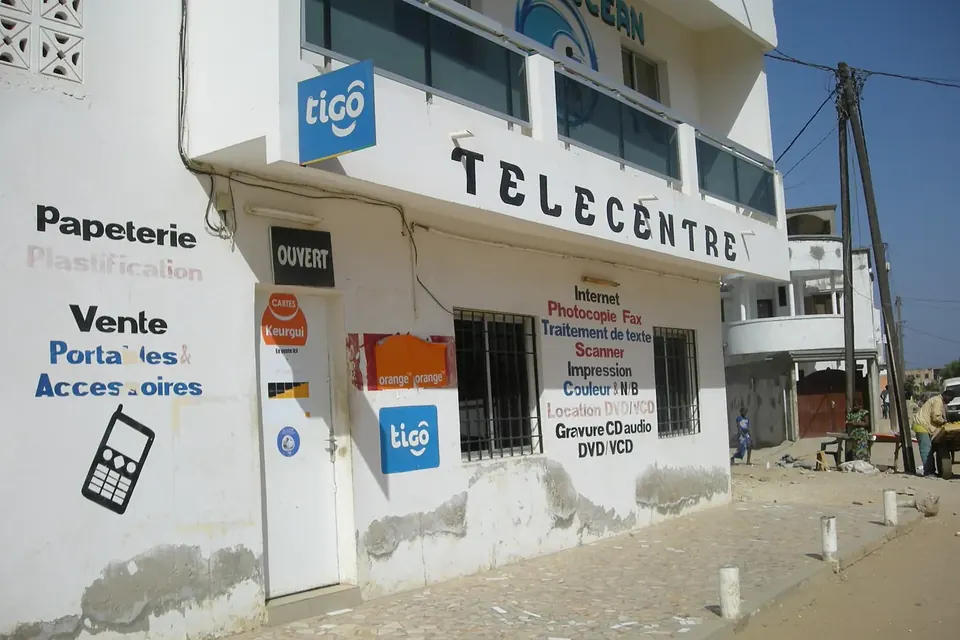
Telecentres, cybercafés, libraries and community centres give people a place to go online with help. Programmes like the UK online centres network in Britain and telecentre networks in Africa, Asia and Latin America have shown that support from a person on site often matters more than the equipment. When an online community knows that some members connect from a shared centre, it can schedule discussions at times when the centre is open, keep pages light, and avoid features that need a personal login on every visit.
Designing for occasional connection
Some simple design choices help people who come online rarely or on poor connections:
- pages that load quickly and work without heavy scripts;
- summaries at the top of long threads, so a newcomer can catch up in minutes;
- email digests, which can be read offline once downloaded;
- clear archives organised by topic and date (see archiving a community's conversations);
- a culture that does not treat slow replies as lack of interest.
Respect and risk
Bringing offline people into an online space means representing them to strangers. Their photos, names and stories should appear only with clear, informed consent, which is hard to obtain when the person cannot see the website. In tense political situations, being named online can be dangerous. A good rule is to publish less about offline participants than one would about oneself.
Measuring whether it works
The test is not how many messages are relayed but whether offline participants influence decisions. Useful questions: How many proposals originated with someone offline? Did they receive answers? Did anything change as a result? Networks that ask these questions regularly tend to find the gaps before they become permanent.
An example of a relay
Consider a rural women's savings group that wants advice from an online network of microfinance volunteers. Its secretary visits the district town once a fortnight. Before her trip, members agree on two questions and she writes them down. At the cybercafé she posts them, along with a short description of the group and a note that answers will be read aloud at the next meeting. Volunteers reply over the following days, keeping their answers short and avoiding jargon. On her next visit she prints the replies, adds the date and the names of those who answered, and brings back the group's follow-up questions. The cycle is slow, but it keeps the group in charge of the conversation, and it costs less than a phone call.
Sources
- International Telecommunication Union, Measuring digital development: Facts and Figures 2024: itu.int.
- GSMA, The State of Mobile Internet Connectivity, annual report.
- FrontlineSMS project history: frontlinesms.com.
- Telecentre.org Foundation and IDRC, A Guidebook for Managing Telecentre Networks, 2011.
- Good Things Foundation, research on digital exclusion in the United Kingdom: goodthingsfoundation.org.